Mileto co-founder and CEO, Rogério Soler, is very forthcoming for a startup founder. Through the hour-long discussion, we came away impressed with his clarity of thought and strong conviction that his product-market of fixed batteries with fast charging fit is better than the other players’ fit of battery swapping.
InsightEV: Is it correct to call Mileto Tech a start-up, or have you been in other businesses for a long time? Can you provide us with a brief background of where you have been till now?
Rogério Soler: It is correct. We decided to start the company in early 2022. So we’ve been around for three years now. I come from a family of entrepreneurs, and Mileto was basically born as a spin-off of another family industry, a factory and supplier of metal components to the four-wheeler industry, based in Porto Real, in the state of Rio de Janeiro.
There, I met Felipe, who was the head of the plant at the time, and Alexandre, who is his brother, both of whom would become my partners at Mileto. We shared an interest in sustainable mobility, and we started discussing opportunities for ventures in this area.

From the early days, they had the name Mileto and the brand already figured out. The brand is a homage to Thales of Miletus, a Greek philosopher credited with the first experiments that conceived electricity in the general sense.
So we started brainstorming and went to the market to look for opportunities. At that point, Brazil was experiencing a boom in the rental market for ICE motorcycles, following the pandemic and the growth of e-commerce, groceries, and food delivery. I think you’ve mentioned in your analysis of Brazil the case of Mottu.
InsightEV: Yes.
Rogério Soler: Mottu is the prime example of this trend. The rental business for motorcycles in Brazil is a rapidly growing market. It’s been growing 130% per year since 2021. Also, at that time, the first electric two-wheeler initiatives in Brazil were starting to appear. The primary case, which did not succeed, was Voltz, a more traditional operation, selling to retail consumers. We figured that there was a gap to be explored in the electric two-wheeler rental business.
From there we started by establishing a supply chain. Felipe, who is our head engineer and our COO today, spent some time in China visiting suppliers, establishing contacts, and we identified the first models that compose our portfolio today.
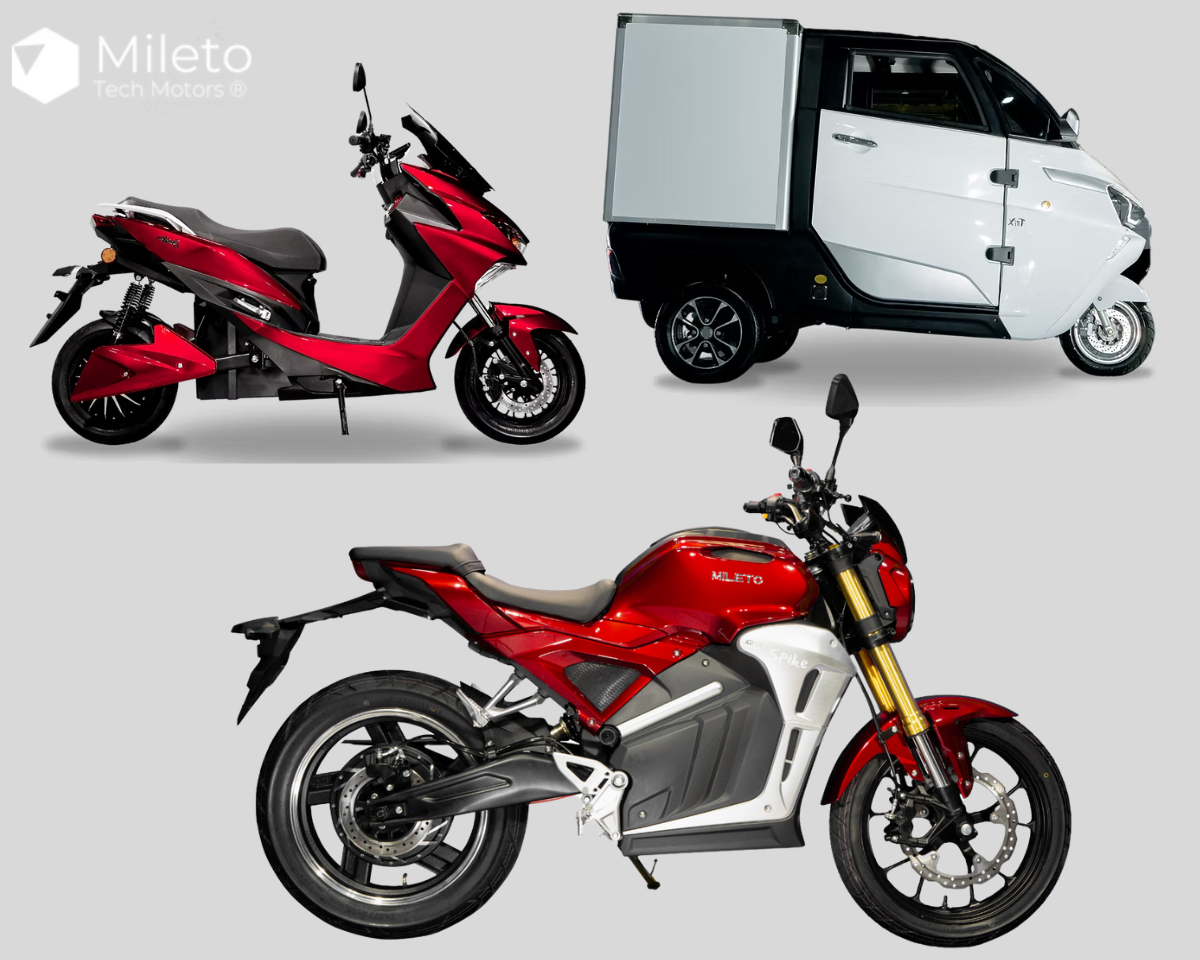
We have a scooter model – Mileto Raiden, a city/naked model with fixed battery – Mileto Spike -, and a three-wheeler cargo model – Mileto Trix. We brought the first samples to Brazil, conducted tests for validation purposes, and requested some adjustments. We always connected closely with foreign manufacturers in China to request adaptations necessary for our reality here in Brazil.
We went through the bureaucracy, which is a problem in Brazil, to validate and license the models, and started operating in mid-2023. So, in July this year, we will complete two years of operation.
We had a one-year validation phase, in which we started small-scale rental operations. We tested B2C rental models, mostly focused on delivery workers but also daily commuters, B2B fleets, and different use case scenarios, both with the three-wheeler model and the motorcycles, and took some lessons from it, learning the needs of each kind of customer, how the products could fit them, and which adjustments and improvements were necessary.
From the end of last year to this point, we have narrowed the aim and are gaining traction with the customer profiles with which we found the best product-market fit. Mileto has been growing a consistent 20% month over month in active rentals since then, which indicates our strategy is going in the right direction.
InsightEV: We would say that’s a very distinct market strategy – the GTM strategy that you have – that you rent motorcycles. Am I correct in saying that you only rent the motorcycles and you are not selling them to customers?
Rogério Soler: Yeah, we are focused on the rental business. There are some reasons for this, but fundamentally, the idea is that rentals, especially for B2B purposes, are a more feasible alternative for fleet owners to use electric power here in Brazil. So, this is the basic strategy.

InsightEV: Last week, we researched the outlook for Brazil, and I spoke to a few participants in Brazil. From what I could sense, delivery riders are the primary target audience for electric motorcycles. Why do you think motorcycles should have fixed batteries when you have delivery riders as the target audience? Is that the case for now, and will you move to a portable or swappable system later?
Rogério Soler: The scooter model allows for battery swapping, but our best-selling model, Mileto Spike, has fixed batteries.
InsightEV: How’s the response for the Spike? Is the range that you get from the Spike sufficient for delivery riders?
Rogério Soler: Independent delivery riders are not our target audience today, but in any case, for them, it will always depend on how to charge the motorcycle during the day. If we take major cities such as São Paulo as an example, we’ll be talking about an average 200km per day that this worker has to ride to leave his or her house, go to the most vital points where pickup is conducted, make the long daily journey and then go back home.
Both Mileto Raiden and Mileto Spike are equipped with 4.3 kWh single batteries, which allow for 100-120km of range with a standard 5 hours for full recharge. So battery swapping or fast recharge are necessary, and we tested both options during our validation phase, making swaps for Mileto Raiden and developing an onboard charger for Mileto Spike that reduces the full charging time to 90 minutes, which is currently the fastest charging time for e-motorcycles available in the Brazilian market.
Both alternatives worked out in our test settings, but you have to make a decision on how to offer them at scale. With respect to battery swapping, as of today, there’s the need for a huge capital investment to install and manage the swapping stations, purchase extra batteries, and this capital needs to be repaid within an acceptable timeframe, especially in Brazil, where interest rates have skyrocketed in the past few years and almost risk-free investment alternatives offer returns up to 15% a year.
From a more general point of view on how to electrify our 2W fleets in Brazil and create an efficient market, battery swapping networks should ideally be shared by the players, which would demand a coordinated effort, even with the public sector, to standardize battery sizes, configurations, have a common infrastructure, and so on. Otherwise, an analogy to what happens is that you sell a car to someone and tell him or her that it can only be fueled at specific gas stations, with a specific kind of gas. It limits the experience and the possibilities of the owner in comparison to ICE vehicles.
On the other hand, swapping works basically as a substitute for a greater range and/or quicker recharge. Battery swapping systems are an entry barrier to the commodity itself, which is electricity. When you look at the evolving technology, the tendency is that batteries become more efficient and charging time is drastically reduced – here we are already working on developments in our Mileto Spike to drop full charging time to 30 minutes.
Taking all these factors into account, I think that investing in battery capacity and fast recharging, both in technology embodied in the motorcycle and publicly available charging infrastructure, is a more reasonable path in terms of best use of limited natural and financial resources and generation of complementary markets in the long run. In Brazil, we have a rapidly growing charging network for four-wheelers, especially in the country’s south and southeast. Making this infrastructure compatible with and available to two-wheelers is something we are already discussing with players in this segment for joint R&D projects, so we will be better prepared to address the open, independent B2C delivery market in the near future.

At this point, our GTM strategy for the short term is to address other specific clients who can already benefit from the motorcycle’s range and charging time based on current technological conditions.
An example is private security patrols. In Brazil, private security services are an annual USD70 billion market, and motorcycles are largely used in security patrols that normally run long periods of time, in some cases even 24h a day, 7 days a week, making patrols in private buildings, neighbourhoods, housing complexes, and so on. Other cases are facilities management activities such as cleaning, material transportation inside industrial plants, etc., and closed-end logistics operations that work within pre-established ranges for e-commerce deliveries, for example.
It is conventional wisdom here in Brazil that motorcycle rental is associated with independent delivery workers, mostly because of Mottu’s success. But we believe that these other commercial customer profiles that I mentioned are highly underestimated in terms of market size and kilometers run per day. We estimate that there are currently 150,000 motorcycles active in Brazil in commercial usage by these segments alone, against roughly 500,000 delivery workers.
So we are addressing a specific niche which is smaller in size, but not negligible at all, and that has specific needs, specially in terms of after-sales maintenance services, with very short SLA. For example, if a private security patrol has a flat tire, it cannot wait a full day to have the motorcycle back on track, and we have to respond to a call from this client to resolve issues in 2-3 hours.
Mileto’s aim is to become a full-service partner of choice for these sorts of clients, offering not only the electric hardware but also great after-sales assistance, which is a key concern today for E2W, if you want to really convince the customer to sustain the decision to electrify the fleet. And these are the clients that can already benefit today from the current technology and extract the most value from it, benefitting from enormous fuel savings, which can reach 80-90% per year, depending on the ICE comparable model that they are used to applying in their operations, with feasible rental prices.
InsightEV: So clearly, your strategy seems to be very different from the other players in Brazil. You want to go for fixed batteries and fast charging. Moving on from there, I’m wondering about your first set of products, the three products that you said: the scooter, the motorcycle, and the three-wheeler. They are from China, and you have worked on them in Brazil to make them locally adoptable. What about the next products? Is your design input increasing in future products?
Rogério Soler: Yeah, for now, we are still relying on Chinese suppliers for the key components such as batteries, but we have already localised supply offers for standard parts. In this phase, we are transferring our assembly line to Manaus, and we will rely on a local assembly partner there. Our internal focus will be directed to R&D, most importantly on the development of charging technology and battery technology for the current models, as already done with the fast charging available for Mileto Spike. This would be stage one of our R&D projects. We are already discussing a project with local partners here for commuting with charging stations for four-wheelers, to allow our motorcycles to be charged in public or private facilities. We are also in conversation with a Chinese partner to increase the life cycles of our current batteries, which is a key concern for us here, or any player in the rental industry.
In a second stage, we will definitely be looking for proprietary designs in the near future. For developing our own models, cost is always a factor to be considered. For now, we have these current portfolio models validated for commercial uses here in Brazil, and we see that there are some aspects that we need to address to open up this portfolio to more specific needs. For example, in some cases, we have security patrols in off-road settings. So development of a dual-sport model will certainly be on our agenda for the coming years. Then there are technologies that we are already testing and are in development, like video monitoring, so not only having the current GPS monitoring system, but also allowing the client to see in real time where the rider is and their present conditions, which can be interesting for these specific segments we are targeting.

InsightEV: I understand dual-sport models are very popular in Brazil. It’s a significant part of the market. Your efforts till now, Rogério, have been self-funded, or have you raised capital from other sources?
Rogério Soler: Until this point, we have bootstrapped; all investment came from the founding partners. We plan an external investment cycle for next year, so we are just finishing the materials to start a road show for a seed round, aiming for mid-2026.
InsightEV: Are you good?
Rogério Soler: We already have the investment cycle for 2025 programmed and secured by the founders, which will expand our current fleet enough to make the company cash flow positive. For the next cycle, we will be looking for external investors to fund an expansion. But we are very steady and grounded in our development, and would be looking for the right kind of investors. The idea is to rely on a partner that can add up to one of the key elements for a sustained expansion, in terms of distribution, after-sales services, or technology, for instance. So, we are aiming for a seed round next year. But the idea is to rely on smart money that could also help us develop the market further.
InsightEV: That sounds interesting. And I’m curious, Rogério, how has the response to the three-wheeler been? You also have it in your portfolio. None of the other players has, so that’s very unique. How has the market responded?
Rogério Soler: It’s been a good response so far, but there are challenges. The key issue here is cost, because inevitably the customer will compare the capacity of an E3W with a regular ICE or even electric four-wheeler, especially when you think about delivery activities. We still have to figure out the cost equation for the product to be really scalable, and we have some options here in Brazil. The first batch we brought was in CBU form for testing purposes. One possibility to make them more cost-efficient for the customer would be to start production in Manaus.
This is something we are discussing with our assembly partner, but we are starting production there in the second semester with the motorcycles, which have seen the most important demand at this point.
Specifically for the three-wheelers, a sort of mess happened that changed the cost equation we had in mind at first. Brazil is a tax mayhem in some aspects. The local four-wheeler industry is very scared of Chinese electric competitors, especially BYD and GWM. At the beginning of its term, the new government that took office in 2023 announced import taxes on electric four-wheelers, which were previously exempt from tariffs. Since tax authorities require us to declare electric three-wheelers in the same tax classification as the electric four-wheelers, the product was severely impacted. You may still have some benefits if you bring the product in CKD or SKD form, but even in these scenarios, there is only a reduction in the import tariff, not a full exemption, and the reductions will cease by 2028.
So if you think long term, it is not a feasible model, and we will have to rely on local production, most likely in the Manaus free trade zone, to make it work.
We have demand, and we have customers at this point. However, the three-wheeler is a sort of novelty here in Brazil. It’s not something that customers are used to.
The same way for four-wheelers or two-wheelers, we face some resistance at the first stage from more skeptical users, mostly because they have to adapt to certain routines such as charging, preparing for the range and so on.
The three-wheeler has a second barrier, though, being not only an electric vehicle, but also an unusual vehicle to our landscape. But in the cases that we have been able to overcome this barrier, the results have been very positive.
Focus Brazil:

 InsightEV – Global Electric Mobility